Bridal Skin Care Timeline: Why Your Plan Should Start with a Dermatologist

Your wedding date is fixed, the venue is booked and the lehenga fittings have started. Somewhere on the long to-do list is “get glowing skin”. Most brides leave this until the last month, then try to fix everything in a few weeks with back-to-back facials. It rarely works, and sometimes it backfires.

Good bridal skin is not built in a week. Acne scars need months of sessions. Pigmentation takes time to fade. Laser hair removal works in cycles spaced weeks apart. The brides who look naturally radiant on their big day are almost always the ones who started early and followed a plan. This guide gives you that plan, month by month, the way a dermatologist would build it.

If you are searching for the best dermatologist in Chandigarh to guide your bridal prep, the most useful thing you can do is book your first consultation as early as possible. Here is why.

Quick answer

  • 6 months before: consultation, start laser hair removal, treat acne, scars and pigmentation.
  • 3 months before: peel series, hair fall treatment, review progress.
  • 1 month before: medi-facials and hydration only. No new procedures.
  • Final 2 weeks: gentle maintenance, sleep, water and sunscreen.

Why bridal skin prep should start with a dermatologist

A parlour can make your skin look fresh for a day. A dermatologist can change what is happening underneath. That difference matters when you have specific concerns like acne, old scars, melasma, dark underarms or thinning hair. These are medical skin issues, and they respond to medical treatment.

The other reason is safety. Brides are often tempted by packages promising dramatic results in a few sittings. Strong peels, bleaching agents or unknown creams used too close to the wedding can cause redness, peeling, rebound pigmentation or allergies at the worst possible moment. A doctor will tell you honestly what is realistic in your timeline and what is not worth the risk.

6 months before: the foundation phase

This is the ideal time to start, especially if you have any long-term concern.

Get a proper skin assessment

Your first visit is about understanding your skin. Are you oily, dry or combination? Is the darkness on your cheeks sun tan, melasma or post-acne marks? Are your breakouts hormonal? Each of these needs a different approach. A clear diagnosis at this stage saves months of guesswork.

Start laser hair removal

Laser hair removal usually needs six to eight sessions, spaced four to six weeks apart, for a significant reduction. Starting six months out means you can finish most of the course before the wedding. Popular areas for brides include the face, underarms, arms, legs and bikini line. As a bonus, many women find that laser reduces the darkness and ingrown hairs caused by years of waxing and shaving.

Treat active acne

If you are still breaking out, this is the priority. Active pimples need to settle before you can work on scars and marks. A tailored acne treatment plan may include prescription creams, oral medication or in-clinic procedures depending on severity. Some acne medicines need several months to work fully, which is one more reason not to leave this late.

Begin scar and pigmentation work

Acne scar treatment with lasers or microneedling typically needs three to six sessions about a month apart, plus time for collagen to rebuild. Pigmentation such as melasma also improves gradually over months, not weeks. Starting now gives you the best chance of visible improvement by the wedding.

4 to 3 months before: the treatment phase

Chemical peel series

A series of peels, chosen carefully for your skin type, helps with dullness, tan, open pores and uneven tone. Options like glycolic therapy or a white peel are usually done every two to four weeks. This is the right window because you still have time to recover between sessions without stress.

Address hair fall

Wedding stress, crash dieting and late nights often trigger hair fall a few months before the big day. If you notice more strands on your pillow or comb, do not ignore it. Simple blood tests can check for common causes like low iron, vitamin D or thyroid issues. In-clinic options such as PRP therapy may be suggested, usually as a series of sessions a few weeks apart.

Body concerns

Brides often want to treat dark underarms, back acne, or uneven tone on the arms and neck, especially with backless blouses and sleeveless outfits. These areas respond to a combination of peels, laser and the right home care, but they need time, so plan them in this window.

Anti-ageing and contouring, if you want it

If you are considering anti-wrinkle injections or fillers, discuss them now. A trial treatment two to three months ahead lets you see how your face responds and adjust if needed. Never try them for the first time in the last two weeks.

Wedding coming up?

Start your personalised bridal skin plan with Dr. Harmandeep K Sidhu as early as you can.

2 months to 1 month before: the polish phase

By now your main concerns should be under control. The focus shifts to radiance and texture.

  • Medi-facials every two to three weeks for hydration and glow
  • Carbon peel for oily skin and visible pores
  • Final laser hair removal touch-up, ideally three to four weeks before the wedding
  • Review your home routine with your doctor and lock it in. No experiments after this point.

The last month: protect what you have built

This is the most important rule of bridal skin prep: do not try anything new in the final four weeks. No new serum, no new facial at a different place, no strong peel, no “just one more” procedure. The goal now is to keep your skin calm and healthy.

  • One gentle medi-facial about five to seven days before the wedding
  • Consistent moisturiser and sunscreen every single day
  • Thread or wax at least four to five days before the first function, not the night before
  • Do a patch test with your makeup artist’s products well in advance
  • Use only natural henna for your mehndi. “Black” or instant-dark henna can contain PPD, which can cause severe allergic reactions on the skin.

Lifestyle habits that show on your skin

No treatment can fully make up for weeks of four-hour nights and endless sweets at pre-wedding functions. A few habits make a visible difference:

  1. Sleep seven to eight hours as often as you can. Dark circles and dull skin are often just tiredness.
  2. Drink enough water through the day, especially if functions involve lots of tea, coffee or late-night dinners.
  3. Eat sensibly. Avoid crash diets. They can trigger hair fall and leave the skin looking tired.
  4. Remove makeup every night, even after long sangeet or cocktail evenings.
  5. Manage stress with short walks, a little exercise or simply some quiet time. Stress can trigger breakouts and hair fall.

Common bridal skin mistakes to avoid

  • Booking a facial the day before the wedding. Even gentle facials can cause temporary redness or small breakouts. Give it at least five days.
  • Using “fairness” or unknown creams. Many contain hidden steroids or mercury that give a quick glow but damage the skin over time.
  • Following a friend’s routine. What worked for her oily skin may not suit your dry or sensitive skin.
  • Squeezing pimples before functions. It leaves dark marks that take weeks to fade and can be harder to hide than the pimple itself.
  • Skipping sunscreen during pre-wedding shopping and outdoor events. Fresh tan undoes months of pigmentation work.

What if your wedding is less than three months away?

Don’t panic. You can still make real improvements. The plan just becomes more focused. Your dermatologist will prioritise what will show the most difference in the time available, usually calming active acne, brightening dull skin and improving hydration, and set aside anything that needs a long recovery. Starting late is fine. Starting with the wrong treatment is the real problem.

Grooms need a plan too

More and more grooms are booking pre-wedding skin consultations, and that is a good thing. Common concerns include beard-area acne, razor bumps, tan, dark circles and early hair thinning. The same timeline applies: start early, treat the main problem first and keep the last month simple.

Why brides choose Athena Skin Clinic

At Athena, every bridal plan is personally designed by Dr. Harmandeep K Sidhu (MBBS, MD Skin), who has over 13 years of experience in medical and aesthetic dermatology and special training in lasers, anti-wrinkle injections and fillers. Her approach is simple and honest: understand the problem, explain the options clearly and treat only what is necessary. You will know what to expect from every session and how your skin should look by your wedding date.

Whether you are six months away or six weeks away, come in for a consultation at our skin care clinic in Chandigarh. You can find us at Athena Skin Clinic, SCO 31, Sarovar Path, Sector 7-C, close to Mohali and Panchkula.

Frequently Asked Questions

How early should I start bridal skin care?

Six months before the wedding is ideal, especially if you have acne, scars, pigmentation or want laser hair removal. Three months is still enough for good results with a focused plan.

How many laser hair removal sessions do I need before my wedding?

Most people need six to eight sessions spaced four to six weeks apart for a significant reduction. Starting about six months before the wedding allows you to complete most of the course.

Can acne scars be treated before the wedding?

Yes, acne scars can be improved with treatments like laser resurfacing or microneedling, but they usually need three to six sessions about a month apart. Starting early gives the best chance of visible improvement.

What should I avoid in the last month before my wedding?

Avoid trying new products, strong peels or any procedure for the first time. Stick to your routine, a gentle medi-facial about a week before, daily sunscreen and good sleep.

When should I get a facial before my wedding?

A gentle medi-facial five to seven days before the first function is usually ideal. It gives a fresh glow while leaving time for any minor redness to settle.

Do grooms also need a pre-wedding skin plan?

Yes. Grooms often deal with beard-area acne, razor bumps, tan, dark circles and early hair thinning. The same principles apply: start early, treat the main concern first and keep the final month simple.

Who will plan my bridal skin treatment at Athena?

Your plan is personally designed by Dr. Harmandeep K Sidhu, MBBS, MD (Skin), who has over 13 years of experience in medical and aesthetic dermatology. Call +91 98721 45466 or email athenaderma@gmail.com to book a consultation.

Book your consultation at Athena Skin Clinic

Speak to Dr. Harmandeep K Sidhu, MBBS, MD (Skin). Call, WhatsApp or email athenaderma@gmail.com.

Athena Skin Clinic

Dermatologist-led skin, hair and laser care in Chandigarh by Dr. Harmandeep K Sidhu, MBBS, MD (Skin).

Popular Treatments

  • Acne Treatment
  • Laser Hair Removal
  • Acne Scar Removal
  • Glow Medi-Facials
  • Psoriasis Treatment
This article is for general information and does not replace a medical consultation. Treatment suitability and results vary from person to person.

Winter Skin Problems in Chandigarh: When to See a Skin Specialist

By late October, Chandigarh’s weather starts to change. The mornings turn crisp, the air gets dry, and by December the fog rolls in and heaters come on in every home. Your skin notices all of it. Tight cheeks after a bath, flaky patches on the shins, cracked heels, itchy arms at night. For most people this is mild winter dryness. For some, it is the start of something that needs a doctor.

As a skin specialist in Chandigarh, we see a clear pattern every year. Appointments for eczema, psoriasis, itching and dandruff start rising in November and stay high until February. Many of these patients have spent weeks trying different creams before coming in. This guide will help you tell the difference between normal winter dryness you can manage at home and the problems that are worth getting checked early.

Quick answer

Mild dryness that improves with a good moisturiser within a week or two is usually fine to manage at home. See a skin specialist if the itching disturbs your sleep, the skin cracks or bleeds, red or scaly patches keep spreading, or a known condition like eczema or psoriasis flares up.

Why winter is hard on the skin in the tricity

Your skin’s outer layer works like a brick wall. The skin cells are the bricks, and natural oils called lipids, including ceramides, are the mortar that holds them together. That wall keeps moisture in and irritants out.

In winter, three things weaken it at once. The air outside holds much less moisture, so water evaporates from your skin faster. Room heaters and blowers indoors dry the air even further. And almost everyone switches to long, very hot showers, which strip away the natural oils your skin depends on. The result is a barrier with gaps in it. Skin loses water, feels rough and becomes more sensitive to soaps, woollens and fragrances.

Add winter habits like drinking less water, wearing scratchy wool directly on the skin and skipping sunscreen because “it’s cloudy”, and it is easy to see why problems pile up between November and February.

Common winter skin problems we see

1. Dry, rough and flaky skin (xerosis)

This is the most common one. Skin on the legs, arms and hands feels tight and looks dull or ashy, sometimes with fine cracks that look like a dry riverbed. It is usually worst on the shins. Most cases respond well to simple changes: shorter lukewarm baths, a gentle cleanser and a thick moisturiser applied within a few minutes of drying off.

2. Eczema flare-ups

If you or your child already have eczema (atopic dermatitis), winter is often the hardest season. Expect red, very itchy patches, commonly in the elbow creases, behind the knees, on the neck and on the face in young children. Scratching breaks the skin further and can lead to infection. Eczema usually needs more than moisturiser. A dermatologist can prescribe the right anti-inflammatory creams for flare-ups and a long-term plan to prevent them.

3. Psoriasis getting worse

Many people with psoriasis find their plaques thicken and spread in winter. Less sunlight, dry air and stress around the holiday season all play a part. Thick, silvery, scaly patches on the elbows, knees, scalp or lower back should be assessed properly, because psoriasis is a long-term condition and the right treatment plan makes a big difference to comfort and quality of life.

4. Winter itch

Some people develop generalised itching, especially at night or after a bath, without much of a visible rash. Dry skin is the most common cause. But persistent itching all over the body can occasionally point to other issues, such as a skin allergy, a fungal infection or, less often, an internal health problem. If itching lasts more than two weeks despite moisturising, it should be looked at.

5. Cracked heels and hands

Heels can crack deep enough to hurt and even bleed, especially for people who walk barefoot at home or wear open footwear. Hands suffer from frequent washing and cold water. A urea-based foot cream at night with cotton socks, and a barrier hand cream after every wash, usually help. Deep, painful cracks that do not heal should be checked, because they can get infected.

6. Chapped lips

Licking dry lips feels like it helps but actually makes things worse, since saliva evaporates quickly and dries them further. A plain, fragrance-free lip balm or petroleum jelly works better than flavoured balms. Cracks at the corners of the mouth that keep coming back may need treatment for an infection.

7. Dandruff and an itchy scalp

Seborrhoeic dermatitis, the medical name for stubborn dandruff with redness, often gets worse in winter. Flakes may also appear around the eyebrows, sides of the nose and behind the ears. Regular anti-dandruff shampoo helps many people, but if flaking is heavy, itchy or spreading to the face, a dermatologist can suggest a more targeted treatment.

8. Fungal infections hiding under layers

It surprises many people, but fungal infections do not disappear in winter. Layers of tight clothing, sweaty socks and woollens that are not washed often can trap moisture in skin folds. Ring-shaped itchy patches in the groin, waist or under the breasts should be examined. Please avoid applying steroid combination creams bought over the counter. They often make fungal infections harder to treat.

Simple winter skin care routine that actually works

  1. Keep baths short and lukewarm. Five to ten minutes is enough. Hot water feels lovely in December but strips your skin’s oils.
  2. Swap harsh soaps for a gentle, soap-free cleanser. You do not need to soap your whole body every day. Focus on the areas that need it.
  3. Moisturise within three minutes of bathing. Pat your skin gently and apply a thick cream or ointment while it is still slightly damp. Look for ceramides, glycerin, urea or petrolatum on the label.
  4. Use a humidifier or a bowl of water near the heater to add some moisture back into the air in your bedroom.
  5. Keep wool away from your skin. Wear a cotton layer underneath sweaters and shawls.
  6. Do not skip sunscreen. UV rays still reach your skin on hazy and foggy days, and winter sun can worsen pigmentation.
  7. Drink water through the day, even if you don’t feel as thirsty as in summer.

Itchy, cracked or flaring skin?

Get a proper diagnosis from a dermatologist instead of trying one cream after another.

When to see a skin specialist

Home care is enough for most mild winter dryness. But please book a consultation if you notice any of these:

  • Itching that keeps you awake at night or lasts more than two weeks
  • Skin that cracks, bleeds, oozes or develops yellow crusts
  • Red, scaly or thickened patches that keep spreading
  • A flare-up of known eczema or psoriasis that your usual routine is not controlling
  • Ring-shaped itchy rashes in skin folds
  • Your child’s skin is very dry, red and itchy, especially on the cheeks and in body creases
  • Over-the-counter creams worked at first but the problem keeps coming back

That last point matters. Many people pick up “skin creams” from the chemist that contain strong steroids. These calm the skin quickly, which feels like success, but long-term use can thin the skin, cause stretch marks and make some conditions much harder to treat later. If a cream is working so well that you are scared to stop it, that is a sign to see a doctor.

What happens at a consultation

At Athena Skin Clinic, consultations are with Dr. Harmandeep K Sidhu (MBBS, MD Skin), a dermatologist with over 13 years of experience and a member of the IADVL and the Chandigarh Dermatology Society. She will ask about your symptoms, how long they have been going on, what you have already tried and whether anyone in the family has similar skin issues. Then she examines the skin closely to confirm the diagnosis.

Winter skin problems often look alike. Dry skin, eczema, psoriasis and fungal infections can all be red and itchy, but they need completely different treatment. Getting the diagnosis right first is what stops the cycle of trying one cream after another. You leave with a clear plan: what to apply, how long to use it, what to stop and when to come back.

Looking after your skin through the season

Winter does not have to mean months of itchy, uncomfortable skin. Small daily habits protect your skin barrier, and early treatment stops minor problems from turning into long flare-ups. If something feels different from your usual winter dryness, it is always better to get it checked sooner rather than later.

You can visit our skin care clinic in Chandigarh at Athena Skin Clinic, SCO 31, Sarovar Path, Sector 7-C. We regularly see patients from Mohali, Panchkula, Zirakpur and nearby towns.

Frequently Asked Questions

Why does my skin get so dry in winter?

Cold air holds less moisture, room heaters dry the air further, and hot showers strip away your skin's natural oils. Together these weaken the skin barrier, so water escapes faster and the skin feels tight, rough and itchy.

Which moisturiser is best for winter?

A thick, fragrance-free cream or ointment with ingredients like ceramides, glycerin, urea or petrolatum works well for most people. Apply it within three minutes of bathing while the skin is still slightly damp to lock in moisture.

Does eczema get worse in winter?

Yes, for many people it does. Dry air and woollen clothing can trigger flare-ups with red, very itchy patches. Eczema usually needs a doctor's treatment plan, not just moisturiser, to control flare-ups and prevent them.

Why is my psoriasis worse in the cold months?

Less sunlight, dry air and seasonal stress can all make psoriasis plaques thicker and more widespread in winter. A dermatologist can adjust your treatment for the season.

Should I use sunscreen in winter?

Yes. UV rays still reach your skin on cloudy and foggy days, and winter sun can worsen tan and pigmentation. A broad-spectrum sunscreen with SPF 30 or higher is a good daily habit throughout the year.

Is it safe to use steroid creams from the chemist for itching?

Strong steroid creams used without medical advice can thin the skin, cause stretch marks and make fungal infections worse. If you need a cream regularly to control itching, it is best to see a skin specialist for a proper diagnosis.

When should I see a skin specialist for winter itching?

Book a consultation if itching lasts more than two weeks, disturbs your sleep, or comes with cracks, bleeding, oozing or spreading red patches. You can call Athena Skin Clinic on +91 98721 45466.

Book your consultation at Athena Skin Clinic

Speak to Dr. Harmandeep K Sidhu, MBBS, MD (Skin). Call, WhatsApp or email athenaderma@gmail.com.

Athena Skin Clinic

Dermatologist-led skin, hair and laser care in Chandigarh by Dr. Harmandeep K Sidhu, MBBS, MD (Skin).

Popular Treatments

  • Acne Treatment
  • Laser Hair Removal
  • Acne Scar Removal
  • Glow Medi-Facials
  • Psoriasis Treatment
This article is for general information and does not replace a medical consultation. Treatment suitability and results vary from person to person.

Festive Glow Plan: Skin Care Clinic Treatments to Book Before Karwa Chauth and Diwali

Karwa Chauth is on 29 October and Diwali follows on 8 November. If you want your skin to look its best for the pujas, the family photos and the long evenings with relatives, now is the right time to plan. Not the night before, and not with a random face pack you saw on Instagram.

At our skin care clinic in Chandigarh, the week after Navratri is when we start seeing the “help, my festival is in two weeks” appointments. The good news is that two to three weeks is enough time to get real, visible results. The catch is that some treatments need recovery time, and booking the wrong one too close to the festival can leave you red, peeling or patchy on the very day you wanted to glow.

This guide walks you through what to book now, what to avoid, and how to look after your skin during the fasting day itself.

Quick answer

  • 2 to 3 weeks before: chemical peels, laser treatments, anti-wrinkle injections and fillers.
  • 5 to 10 days before: medi-facials, carbon peel or Carbon Q facial, skin polishing.
  • Last 5 days: no new products, no strong peels, no waxing on the face. Hydrate and protect.

Why timing matters more than the treatment itself

Most people pick a treatment first and a date second. For festive skin, it should be the other way round. Every procedure has a settling period, the time your skin needs to calm down after it has been worked on. A light medi-facial may leave you glowing the next morning. A medium-depth peel can cause flaking for five to seven days. Anti-wrinkle injections take roughly one to two weeks to show their full effect, and fillers can leave mild swelling or bruising for a few days.

So when someone asks us “what is the best treatment for Diwali glow?”, the honest answer is: it depends on how many days you have, your skin type and what is bothering you. Dull skin, tan, uneven tone, active pimples and fine lines all need different approaches.

Treatments to book now (2 to 3 weeks before)

1. Chemical peels for tan, dullness and uneven tone

After a long, hot summer and a humid monsoon, many people in the tricity are carrying stubborn tan and patchy pigmentation. A dermatologist-chosen peel, such as a glycolic peel, a white peel or a carefully graded TCA peel, removes the dull top layer and helps even out tone.

Light peels usually settle in two to four days. Deeper peels need a full week or more. That is exactly why this is the week to do them. If you have sensitive skin or a history of pigmentation, your doctor may suggest a gentler peel and a longer gap.

2. Laser hair removal

If you are tired of last-minute threading and waxing before every function, this is a good time to start laser hair removal. One session will not make hair disappear, since a full course usually needs several sessions spread four to six weeks apart, but you will notice softer, slower regrowth. Book it at least 10 to 14 days before the festival so any mild redness has fully calmed down.

3. Anti-wrinkle injections and fillers

If fine lines on the forehead or around the eyes bother you in photos, anti-wrinkle injections work well, but only if they are done early enough. Results start appearing in a few days and settle fully in about two weeks. The same logic applies to dermal fillers, where small bruises or swelling may take a few days to fade. Getting these done the week before Karwa Chauth is cutting it fine. This week or next is ideal.

4. Acne control

Nothing ruins festive confidence like a fresh crop of pimples. If you are breaking out, do not wait. A short course of the right acne treatment started now can calm active breakouts within two to three weeks. Please avoid popping pimples yourself before the festival. That is how a five-day spot becomes a five-week dark mark.

Treatments for the final 5 to 10 days

Medi-facials

Unlike a regular parlour facial, a medi-facial uses clinical-grade products chosen for your skin type: hydrating for dry skin, oil-control for acne-prone skin, brightening for dull skin. There is little to no downtime, which makes it a safe choice five to seven days before the festival.

Carbon peel and Carbon Q facial

Often called the “Hollywood peel”, carbon peel and the Carbon Q facial are popular with people who have oily skin, open pores and a dull complexion. The skin often looks fresher and tighter right after the session, with only mild pinkness that settles within hours.

Skin polishing and hydration boosters

Diamond skin polishing gently exfoliates and suits most skin types. If your skin tends to feel tight and dry by October, a hydration-focused session or vitamin therapy can make makeup sit much better.

Two weeks to Karwa Chauth?

Book a skin consultation now so your treatments have time to settle before the festival.

What to avoid in the last week

  • Trying a new serum, cream or face pack. The week before a festival is the worst time to discover an allergy.
  • Strong peels or scrubs at home. Over-exfoliating causes redness and stinging, especially under makeup.
  • Bleach on the face. It can irritate the skin and leave patches, particularly on sensitive or acne-prone skin.
  • Facial waxing two days before. If you have not started laser, thread or wax at least three to four days in advance.
  • Black henna or “instant dark” mehndi. Some of these contain PPD, a chemical that can cause severe allergic reactions. Stick to natural henna and do a small patch test.

Karwa Chauth fasting day: simple skin care that works

A full day without water can leave your skin looking tired by evening, right when the moon comes out and the photos begin. A few small steps make a real difference:

  1. Load up on water during sargi. Include water-rich fruits like orange, papaya or watermelon, and go easy on very salty or fried foods that cause puffiness.
  2. Use a moisturiser with ceramides or hyaluronic acid in the morning, before makeup. Hydrated skin holds makeup better and looks less flaky.
  3. Do not skip sunscreen if you will be outdoors during the day. Even mild October sun deepens tan and pigmentation.
  4. Keep a facial mist handy to refresh your skin before the evening puja without disturbing your makeup.
  5. Remove makeup properly at night, however tired you feel. Sleeping in heavy festive makeup is a common trigger for breakouts in the days that follow.

After Diwali: don’t forget recovery

The week after Diwali brings smoke, pollution and late nights. Many patients come in with dull skin, sudden breakouts or flare-ups of eczema. Keep your routine simple: a gentle cleanser twice a day, a good moisturiser and sunscreen. If your skin stays irritated for more than a week, it is worth getting it checked instead of layering more products on top.

A note on festive offers and “instant glow” promises

Around this time of year you will see plenty of discounted packages promising fair, glowing skin in one sitting. Some are fine. Others involve strong bleaching agents or steroid creams that give a quick glow and cause problems later, including thinning skin, redness and rebound acne. Before booking anything, ask who will be doing the procedure, what exactly is being used and how much downtime to expect. A qualified dermatologist will happily answer all three.

Why a doctor-led skin care clinic makes a difference

The difference between a festive treatment that works and one that backfires is usually the assessment beforehand. At Athena, every plan starts with a consultation with Dr. Harmandeep K Sidhu (MBBS, MD Skin), who has over 13 years of experience in medical and aesthetic dermatology. She looks at your skin type, any active acne or pigmentation, your past reactions and, just as importantly, how many days you actually have before your event. Then she suggests only what makes sense for that window.

Sometimes that means a peel this week and a medi-facial next week. Sometimes it means skipping procedures entirely and fixing your home routine. Either way, you get an honest plan that keeps the festival day safe.

If you are looking for a skin specialist in Chandigarh before the festive season, you can visit us at Athena Skin Clinic, SCO 31, Sarovar Path, Sector 7-C, easily reachable from Mohali and Panchkula as well.

Frequently Asked Questions

How many days before Karwa Chauth should I get a chemical peel?

For light peels, about 7 to 10 days before is usually safe. Medium-depth peels need at least two weeks because the skin can flake for up to a week. Your dermatologist will choose the peel strength based on your skin type and the days you have left.

Is a medi-facial better than a parlour facial for festivals?

A medi-facial uses clinical-grade products selected for your skin concern, such as hydration, oil control or brightening. It is done under a dermatologist's supervision and has little to no downtime, which makes it a safer choice before a big occasion, especially if you have sensitive or acne-prone skin.

Can I get laser hair removal one week before Diwali?

It is better to keep at least 10 to 14 days between a laser session and the festival so any redness has fully settled. If you are close to the date, threading or waxing four to five days before is a safer option.

When should I get anti-wrinkle injections before a festival?

Ideally two to three weeks before. Results begin within a few days and settle fully in about two weeks. Getting them done in the last week leaves no time to review the result or correct anything.

How can I keep my skin fresh during the Karwa Chauth fast?

Drink plenty of water and eat water-rich fruits during sargi, moisturise well in the morning, wear sunscreen if you go outdoors and carry a facial mist for the evening. Remove your makeup properly at night to avoid breakouts the next day.

Is black mehndi safe for the skin?

Black or instant-dark henna can contain PPD, which can cause serious allergic reactions, blistering and lasting marks. Natural henna is a safer choice. If you have sensitive skin, do a small patch test a day or two before.

Where is Athena Skin Clinic located?

Athena Skin Clinic is at First Floor, Inner Market, SCO 31, Sarovar Path, Sector 7-C, Chandigarh 160019. It is easy to reach from Mohali, Panchkula and Zirakpur. You can call +91 98721 45466 to book.

Book your consultation at Athena Skin Clinic

Speak to Dr. Harmandeep K Sidhu, MBBS, MD (Skin). Call, WhatsApp or email athenaderma@gmail.com.

Athena Skin Clinic

Dermatologist-led skin, hair and laser care in Chandigarh by Dr. Harmandeep K Sidhu, MBBS, MD (Skin).

Popular Treatments

  • Acne Treatment
  • Laser Hair Removal
  • Acne Scar Removal
  • Glow Medi-Facials
  • Psoriasis Treatment
This article is for general information and does not replace a medical consultation. Treatment suitability and results vary from person to person.

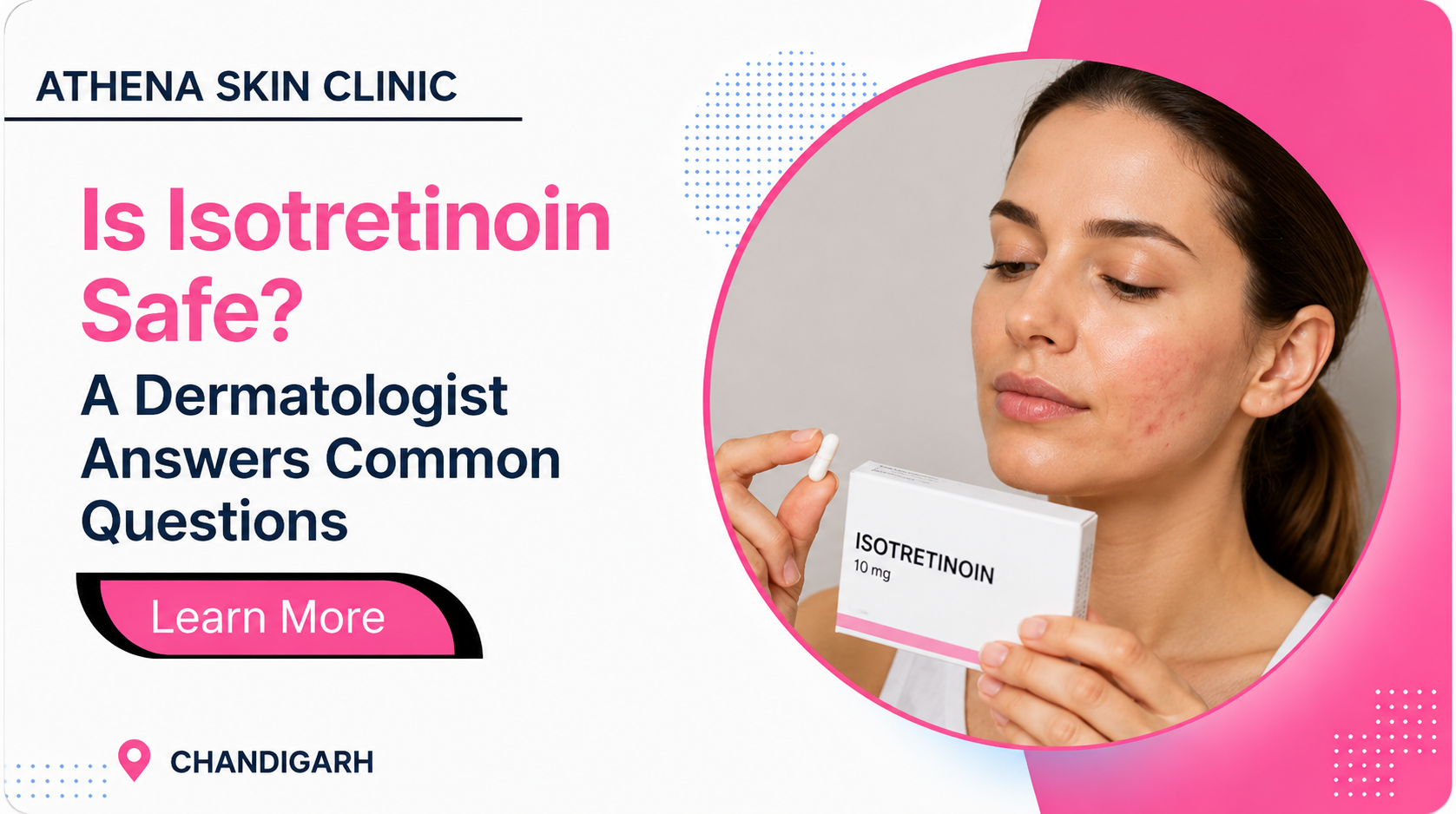
Is Isotretinoin Safe? A Dermatologist Answers Common Questions

Is Isotretinoin Safe? A Dermatologist Answers Common Questions

Yes, isotretinoin is safe for the vast majority of patients when it is prescribed for the right kind of acne and monitored properly by a dermatologist. It remains the most effective treatment available for severe, scarring, or antibiotic-resistant acne, and most people complete a course with nothing worse than dry lips and dry skin. The medicine does carry serious risks — birth defects if taken during pregnancy, and less common effects on the liver, blood fats (lipids), and mood — but these are why isotretinoin is a prescription-only, monitored treatment rather than a reason to fear it outright. The right question isn’t “is it dangerous,” it’s “am I being monitored the way I should be.” Below, we go through the specific concerns patients actually bring into the clinic — side effects, the depression debate, sun exposure, liver damage, and how long it takes to work — with what the current research actually says.

This article was reviewed by Dr. Harmandeep K. Sidhu, dermatologist at Athena Skin Clinic, Chandigarh.

What Exactly Is Isotretinoin?

Isotretinoin (sold under brand names like Accutane, Sotret, or Isotroin in India) is an oral retinoid derived from vitamin A. It’s reserved for moderate-to-severe nodular acne, cystic acne, or acne that keeps scarring the skin despite antibiotics and topical treatments. According to a 2025 clinical review on the NIH’s StatPearls database, isotretinoin works by reducing sebaceous gland size and sebum production, normalizing skin cell turnover, and reducing inflammation in the skin — addressing acne at its root causes rather than just calming a flare-up.

Is Isotretinoin Safe for Long-Term Use?

Isotretinoin isn’t a long-term daily medication — it’s typically prescribed as a single, finite course of 4 to 8 months, calculated by body weight, after which most patients don’t need it again. Safety data has been building for decades, and a five-year retrospective clinical analysis published in 2025 found the treatment’s side-effect profile is dominated by manageable, reversible skin issues rather than dangerous internal damage: researchers reported xerosis (dry skin) in about 70% of patients, retinoid dermatitis in around 20%, and cheilitis (chapped lips) in roughly 15.5%. That pattern — very common, mostly cosmetic side effects, and much rarer serious ones — is consistent across most published research on the drug.

What Are the Most Common Side Effects?

The side effects patients notice week to week are almost always related to dryness, because isotretinoin shrinks the oil glands throughout the body, not just on the face:

  • Dry, cracked lips (cheilitis) — the most universally reported effect
  • Dry skin, especially around the nose and cheeks
  • Dry eyes and mild photophobia (light sensitivity)
  • Occasional nosebleeds from dry nasal passages
  • Sun sensitivity, making daily SPF non-negotiable during treatment

A separate 2025 questionnaire-based study on isotretinoin patients also flagged hyperlipidemia (raised blood fats) and elevated liver enzymes as issues that require monitoring but are not universal side effects — which is exactly why your dermatologist orders blood work before and during treatment, rather than prescribing and forgetting.

Does Isotretinoin Cause Depression? (The Question Everyone Asks)

This is, by far, the most searched and most misunderstood concern about isotretinoin — and it comes up constantly on Reddit’s r/SkincareAddiction and Accutane forums. Here’s what the actual evidence shows:

The link is not proven, and newer large-scale data leans the other way. A 2025 Q&A published via the Journal of the American Academy of Dermatology’s Ethics Journal Club noted that larger trials have failed to trace a link between isotretinoin and depressive or suicidal thoughts, and that population-level data, including multiple meta-analyses, actually found reduced depressive symptoms and lower antidepressant use and suicide rates in patients treated with isotretinoin compared to those left untreated.

This makes clinical sense once you separate two different things: acne itself, and the drug used to treat it. A systematic review and meta-analysis found a significant association between acne vulgaris and both depression and anxiety even before any treatment begins. So when mood improves after starting isotretinoin, it’s often the acne clearing — and the confidence that comes with it — doing the work.

That said, a minority of patients genuinely do experience mood changes during treatment. A 2023 study following adolescent patients found that about 10.5% of patients treated with isotretinoin experienced some mood change, most commonly depressive symptoms, anxiety, or emotional lability, and that these changes tended to appear in younger patients and those with a prior psychiatric history. Crucially, the same study found these changes were usually short-lived and resolved to baseline regardless of how treatment was managed — suggesting they weren’t always driven by the drug itself.

The responsible answer: if you have a personal or family history of depression, tell your dermatologist before starting. You don’t need to avoid isotretinoin, but you may be monitored more closely, started at a lower dose, and checked in on regularly — which is standard, sensible practice, not a red flag.

Can Isotretinoin Cause Permanent Liver Damage or Other Organ Damage?

This is a real risk that needs monitoring, but genuine drug-induced liver injury on isotretinoin at standard doses is uncommon, and it’s almost always reversible when caught early through routine blood tests — which is precisely why dermatologists order baseline and periodic liver function and lipid panels throughout treatment rather than treating this as optional. Elevated liver enzymes and raised cholesterol/triglycerides are the two lab abnormalities to actually watch for, and both typically normalize after the dose is adjusted or the course ends.

Is It Safe to Take Isotretinoin in Summer or Sunny Weather?

A common belief often repeated online and even by some clinics is that isotretinoin should be avoided in summer because it makes skin dangerously photosensitive. A 2025 retrospective cohort study designed specifically to test this found the opposite of what’s assumed: adverse events were actually reported less often during sunny months (28.3%) than non-sunny months (39.2%), and treatment discontinuation because of side effects was negligible in both seasons. The takeaway isn’t “sun exposure doesn’t matter” — daily broad-spectrum sunscreen is still essential on isotretinoin — but the idea that you must wait for winter to start treatment isn’t well supported by current evidence..

Who Should NOT Take Isotretinoin?

Isotretinoin is contraindicated or requires extra caution in a few clear situations:

  • Pregnancy or planning a pregnancy — isotretinoin causes severe, well-documented birth defects. This is the single non-negotiable safety rule of the drug. Regulatory bodies including the UK’s MHRA continue to tighten guidance here: as of late 2025, updated guidance allows pregnancy testing to be supervised remotely, balancing patient access with rigorous safeguarding, but a negative pregnancy test before starting, and reliable contraception throughout treatment, remain mandatory for anyone who could become pregnant.
  • Untreated liver disease or very high triglycerides
  • A history of bipolar disorder — some patients have reported worsening symptoms, so this needs a careful risk discussion with your dermatologist
  • Known allergy to retinoids or vitamin A derivatives

How Long Does Isotretinoin Take to Work?

Most patients notice less oiliness within the first few weeks, with visible improvement in acne lesions by the second or third month. A full course usually runs 4–8 months depending on cumulative dose and body weight, and for most patients, results are long-lasting after the course ends — which is what separates isotretinoin from topical treatments that only work while you’re using them.

What Monitoring Should I Actually Expect?

If a course of isotretinoin is being managed properly, expect:

  1. A pregnancy test before starting (if applicable), repeated periodically through treatment
  2. Baseline liver function and lipid (cholesterol/triglyceride) blood tests, repeated at follow-up visits
  3. A documented discussion about mood, mental health history, and what symptoms to flag immediately
  4. A dosing plan based on your body weight, adjusted based on side effects and blood work
  5. Clear guidance on daily moisturizer, lip balm, and SPF, since dryness and sun sensitivity are near-universal

If your treatment plan skips these steps, that’s the real safety question to raise — not whether the drug itself is inherently unsafe.

What Our Dermatologist Says

“Most of the fear around isotretinoin comes from outdated stories, not current evidence. When we screen patients properly, monitor blood work through the course, and check in on mood and side effects at every visit, it’s one of the safest and most effective treatments we have for acne that’s leaving scars. The patients who struggle are usually the ones who were never monitored in the first place.” — Dr. Harmandeep K. Sidhu, Dermatologist, Athena Skin Clinic, Chandigarh Read More About Dr. Harmandeep Sidhu 

Managing Dryness and Skin Barrier Issues While on Isotretinoin

Since dryness is the side effect nearly every patient experiences, skin barrier support matters more during an isotretinoin course than almost any other time. If you’re building out a related content cluster, two existing pieces are genuinely useful companion reads here:

  • Patients often reach for harsh antiseptics on dry, irritated skin thinking it’ll help — our piece on what happens when you apply Dettol on pimples is a relevant caution for anyone on isotretinoin tempted to “disinfect” already-compromised skin.
  • For patients asking what actually helps rebuild the skin barrier during and after treatment, are peptides in skincare worth it? is directly relevant to barrier-repair routines during isotretinoin therapy.

I’d hold off on linking the antifungal, vitamin B12, glutathione, skin-whitening, and white-patches posts here — they’re good content, but they’re not topically close enough to an isotretinoin safety article to help either readers or AI answer engines see this as a coherent internal cluster. Forcing the link would weaken topical relevance rather than strengthen it.

Considering isotretinoin for your acne? Book a consultation with Dr. Harmandeep K. Sidhu for a proper evaluation before starting any oral acne treatment.

Disclaimer: This article is for informational purposes and does not replace a consultation with a dermatologist

People Also Ask

Is Accutane the same as isotretinoin?

Yes. Accutane was the original US brand name (discontinued); isotretinoin is the generic drug name, sold under various brands including Isotroin and Sotret in India.

Can isotretinoin cause hair loss?

Temporary hair thinning has been reported by some patients, usually reversible after completing the course. It’s far less common than dryness-related side effects.

Is one course of isotretinoin usually enough?

For most patients, yes — a full weight-based course clears acne long-term. A minority need a second course if acne returns.

Does isotretinoin cause inflammatory bowel disease (IBD)?

Earlier case reports raised this concern, but larger population studies have not established a clear causal link. If you have a personal or family history of IBD, discuss it with your dermatologist before starting.